

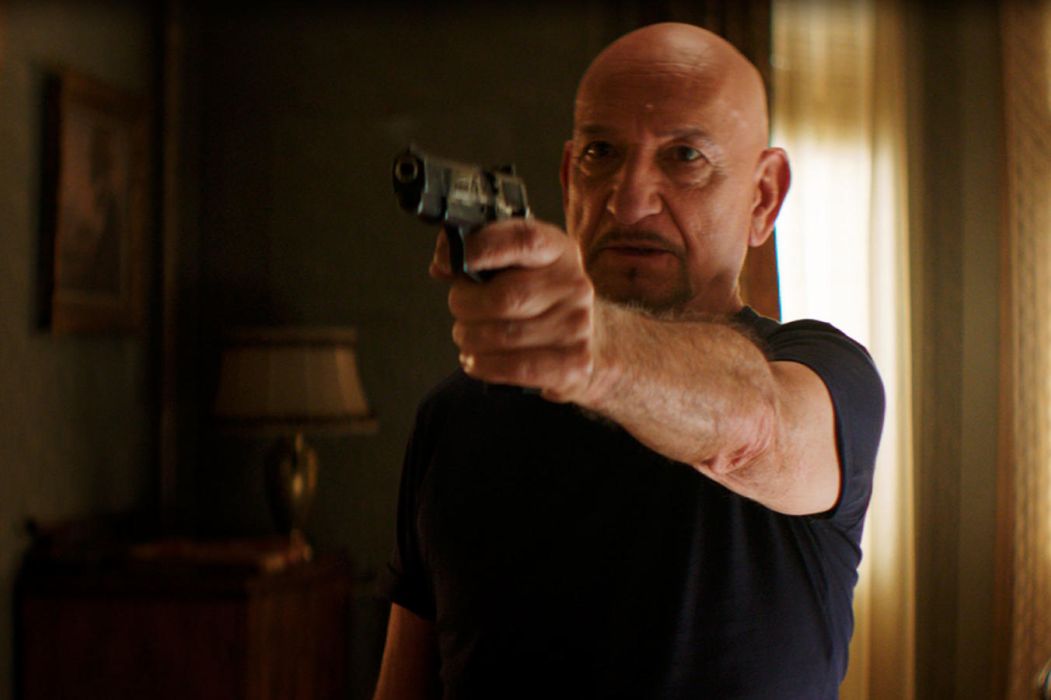
[Published at Film Inquiry] Brad Silberling is one of the most versatile writers and directors working in the industry today. From Casper and A Series Of Unfortunate Events (2004), to City Of Angels and Moonlight Mile, to Jane The Virgin, Silberling can effortlessly jump from family films to those that have more adult themes, and from film to TV, and back to film again. There’s never a dull moment in his filmmaking career. Silberling’s latest film, An Ordinary Man, finds the director at the top of his game. The film is about a war criminal (Ben Kingsley) who develops a unique relationship with his maid (Hera Hilmar), and it is shot on location in Belgrade, Serbia.
On the cusp of An Ordinary Man‘s release, I spoke with Brad Silberling about what drew him to write such a daring script, working with Sir Ben Kingsley, the uneasiness but ultimate rewarding feeling of shooting on location in Serbia, his IMDb “trademark” as a director, Casper, and what’s next on his plate as a filmmaker.

Brad Silberling – source: Click Star
Alex Arabian of Film Inquiry: Congratulations on an excellent new film, An Ordinary Man.
Brad Silberling: Thank you! Thrilled that you got to see it [laughter].
Me as well. One might say that the subject matter in An Ordinary Man is controversial. It’s quite difficult to humanize and bring sympathy to a war criminal, yet you manage to do so and make the audience forget what The General is. What intrigued you to write this amazing script?
Brad Silberling: Pretty simple. I knew nothing of the Balkans, but that is to say, I knew nothing of, really, war-torn cultures. So I picked up three movies over the years since the Sarajevo Film Festival. I filmed Moonlight Mile, which I was in Berlin with back in 2002, but two very sweet people came running up after the screening and threw this scarf around my neck, and this was when the film was in Sarajevo, and said, “we needed this message of healing at this time,” and this was after the wars were concluded, but still pretty fresh. So, I spent time there and was both struck, intrigued, and outraged thinking that there were still perpetrators of the many atrocities who not only weren’t captured but were brazenly moving about the region and were still in many cases considered heroes.
And that’s not just on the Serbs side, that’s’s also on the Croats side, and on the Bosnian side. But just as a storyteller, god, it’s like how was justice exacted truly for these people and if they seemed to be able to kind of moved about? And I realized that it had to be emotional justice, for me, just to make sense, because these are human actions. And that’s why it was controversial. It’s not a Marvel universe where, fortunately, the villains are mythological. Unfortunately, I do believe the worst of actions that you see are by human beings. And they have human tastes and they have dimension. And we may not like that dimension, but it’s there, and they can be infuriating, they can be entertaining, they can be menacing because they are human.
So, I wanted to create a depiction of who is the kind of personality who could have not only done some of these things, but to see how it was that he probably got to where he was, through, as I say, being literally, not only commandeering but entertaining and seductive, and it boosts us on an interpersonal level. And then we have him go through this personal hell? And I do believe, it’s interesting, back when Saddam Hussein was finally captured in that horrible spider hole and brought in to be put in isolation. And the man, think about all of the wealth and the country he had. His days came down to waiting, crawling the walls for a visit from one person. The only person they gave him permission to speak with was a young FBI agent. And he lived with that connection.
And I remember that striking me as seeming like that is the only, that is the only way that you can essentially – you access that human need, and the only way to punish that is through that human need. In this case, a man who refuses to take responsibility for his own daughter’s suicide, who essentially recreates it. So, that was my way in. When I was reading up about the hate tribunals and Serbia and Bosnia, all these Countries trying to win over the EU for membership, they actually said “You’ve gotta bring these guys in.” So, that’s when you start to hear the details, lives moved around like chess pieces. So, all of that went into my creating the script.
Wow, that’s incredible. What was your experience working with such a powerhouse like Ben Kingsley?
Brad Silberling: Oh, it was great. He could – you know what? Here’s the thing. I adore him because he’s the greatest story collaborator. And I will say that…it’s like with Phil Jackson, my wife read his book. I didn’t read it. But I remember her stopping and saying, he basically said, “am I teaching fundamentals from the likes of all these guys, [Michael] Jordan and Scotty Pippin?” But what we’re doing is we’re coming together. I am leading. I’m playmaking, and they’re collaborating with me on playmaking. And then, I get to take advantage of their incredible talent.
With Kingsley, from the first time we met, I did have one question for him. And I knew he had read the script and he was very enthusiastic about it. I said, “Can you play this character without judging him?” He said, “Oh, dear boy, that’s why I’m here, of course.” Because he refuses to judge himself, and so that’s why he’s so unbridled, and why the hubris is so great and why he’s, again, so seductive, and why he loves so hard and all of that.
I mean, we basically partnered. I knew that he was interested in producing adult dramas. And I said to him, “You’re gonna get paid nothing. Can you go with that?” He said, “I’m right here.” And so we shook hands and it took about a good year, year-and-a-half after that between finding financing – but in the process of making the movie itself, it was effortless because, again, moment-to-moment we would – I would just be, again, taking advantage of his instrument in serving the story. And I’d say, “I think in this moment – can this be one of those incredible moments where he had been hiding a bit more, and covering a bit more?” Or, “let’s turn the metronome up, here,” because he’s trying to, sort of under – again, it’s like a Stradivarius, how do you get to play with it?
That sounds like an amazing experience. You capture such beautiful, sweeping images of Belgrade, Serbia. Did you always plan on shooting An Ordinary Man on location in Serbia?
Brad Silberling: Well, I definitely always planned on shooting [laughter] on location. I should be honest, as I was writing, I didn’t know if I’d ever be able to shoot it in Serbia because of the political sensitivity. You’ve got a country that’s still – I was just in Poland in November – the whole of Eastern Europe is now definitely swinging back the pendulum to leaning towards more of a true nationalistic fervor, which is disturbing, to say the least. What I thought I knew of Serbia was that it was still a divided country, but still a nation of true nationalists that would think this character a hero. And so he’s in this hell at the end of the movie, and I thought, “god, I can’t imagine they would necessarily support it, and would that be a safe shooting environment?”
But thankfully, I reached out. I was introduced to a woman who works with the main production and service company in Belgrade. She’s awesome. And she said, “I completely think you could do this here. Let me give your script to the Minister of Culture.” And the response that came back was, “Well, this is exactly what we need to be doing right now. We’re trying to shine a light in all corners.” So, I got reassured that I could safely work there. So, it was sort of a dream come true. I would say, in all honesty, I don’t think – I probably would have tried to shoot in Croatia – there’s not much of a production base in Bosnia, though, so, yeah.
You’ve had such a diverse career in TV and film. IMDb proclaims that your trademark is the death of a loved one.
Brad Silberling: Oh, that’s funny. I haven’t– I have not read that [laughter].
Do you agree with this?
Brad Silberling: I wouldn’t dispute it. The good thing is I had an incredible – in film school – I had three great mentors – but in film school, I met this wonderful director named Martin Ritt. Martin had made Norma Rae and The Spy Who Came From The Cold. He’s just a fantastic director. Marty said to me – he read my thesis script that I wrote, and which he agreed to, essentially, mentor me on. And he said to me, “Have you ever written this before?” And I looked at him like he’s nuts. I said, “You need to be more specific.” He said, “No, have you ever written this story before? The character names could’ve been different, sexes could’ve been different, wardrobes different.” But then he stopped, I looked at him. He nodded, and he said “Good, you’re gonna be telling the same story your whole life [laughter].” And that always stuck with me.
I do think that if loss and transformation is a hopeful journey and a bittersweet journey, it can even be – it’s funny, I adore this small film I did with Morgan Freeman in 2006; it’s called 10 Items Or Less, it all takes place in a day, and it’s two strangers who meet. And the most honest thing they say to each other at the end of the picture is, “We’ll never see each other again.” And, in a way, there, there’s that little loss, that little death there as well, which is, in daring to be honest and daring to be intimate with other people, the loss can come with that. It doesn’t mean that the relationship wasn’t transformational. Isn’t that interesting? It’s probably the case here, though, with him, because of the character, sadly. He’s just gonna keep recreating that loss because he cannot take responsibility for his actions.

source: Saban Films
I’d be remiss if I didn’t mention Casper. It’s a film that is near and dear to my heart, as I watched it at an integral part in my childhood. Do you enjoy making children’s movies or adult-themed films more?
Brad Silberling: You know what’s crazy is they’re all the same to me. I mean, Alfonso Cuarón is a friend, he always says, “Every film is personal,” and he’s right. So, when I was making Casper, I didn’t have a sense of making a family film. I just was in Christina [Ricci]‘s shoes. And I thought, “What is the experience of coming into this situation?” And then, Casper’s shoes, too, or whatever they are.
And so, it’s always the story. And if the story gets me and if there’s an emotional connection. I mean, loss is all over that film and yet, it is transformational to that friendship. If the story can sustain me through the years it takes to get the film made, then I’m good. So, I’ve enjoyed them all because, like I said, I don’t really distinguish, it’s never a really conscious distinction.
Right, that makes sense. Any exciting projects on the horizon for you?
Brad Silberling: Oh, well, yeah, a couple ones. Today’s my last day of directing from the pilot side. I jump back and forth. We’re doing this insane [remake of] Charmed, the 90s TV show Charmed. I finished shooting today. We’re giving it a makeover, and the show’s going to be fantastic.
Oh, wonderful.
Brad Silberling: It’s a Latina cast, it’s Melonie Diaz, who is incredible, from Fruitvale Station, is my lead sister. It’s Jennie [Snyder] Urman and I, who were partners on Jane The Virgin. So, that thing is crazy town. So, that will hopefully be coming to smaller screens soon. And then I’ve written a few originals I’m really excited about it. Again, it’s sort of a human dramedy. And I’m casting that right now. So, we’re making that later in the year.
Oh, that’s wonderful. Well, Brad, I really appreciate you taking the time to speak with me. It’s been nice talking with you, and thanks for sharing your insight.
Brad Silberling: Oh, you too. And my pleasure, and I’m glad Casper was with you back then, that’s great [laughter].
Film Inquiry would like to thank Brad Silberling for speaking with us.
An Ordinary Man is released theatrically and on VOD on April 13, 2018 in the U.S. For more information on its release, click here.
Film Inquiry supports #TimesUp.
“The clock has run out on sexual assault, harassment and inequality in the workplace. It’s time to do something about it.” Read the Letter of Solidarity here. Make a donation to the legal fund here.


Leave a Reply
Your email is safe with us.